Why Sociology Optional Is Becoming a Popular Choice for UPSC Aspirants
Discover why Sociology Optional is gaining popularity among UPSC aspirants. Learn its overlap with GS, scoring potential, and strategic preparation benefits.
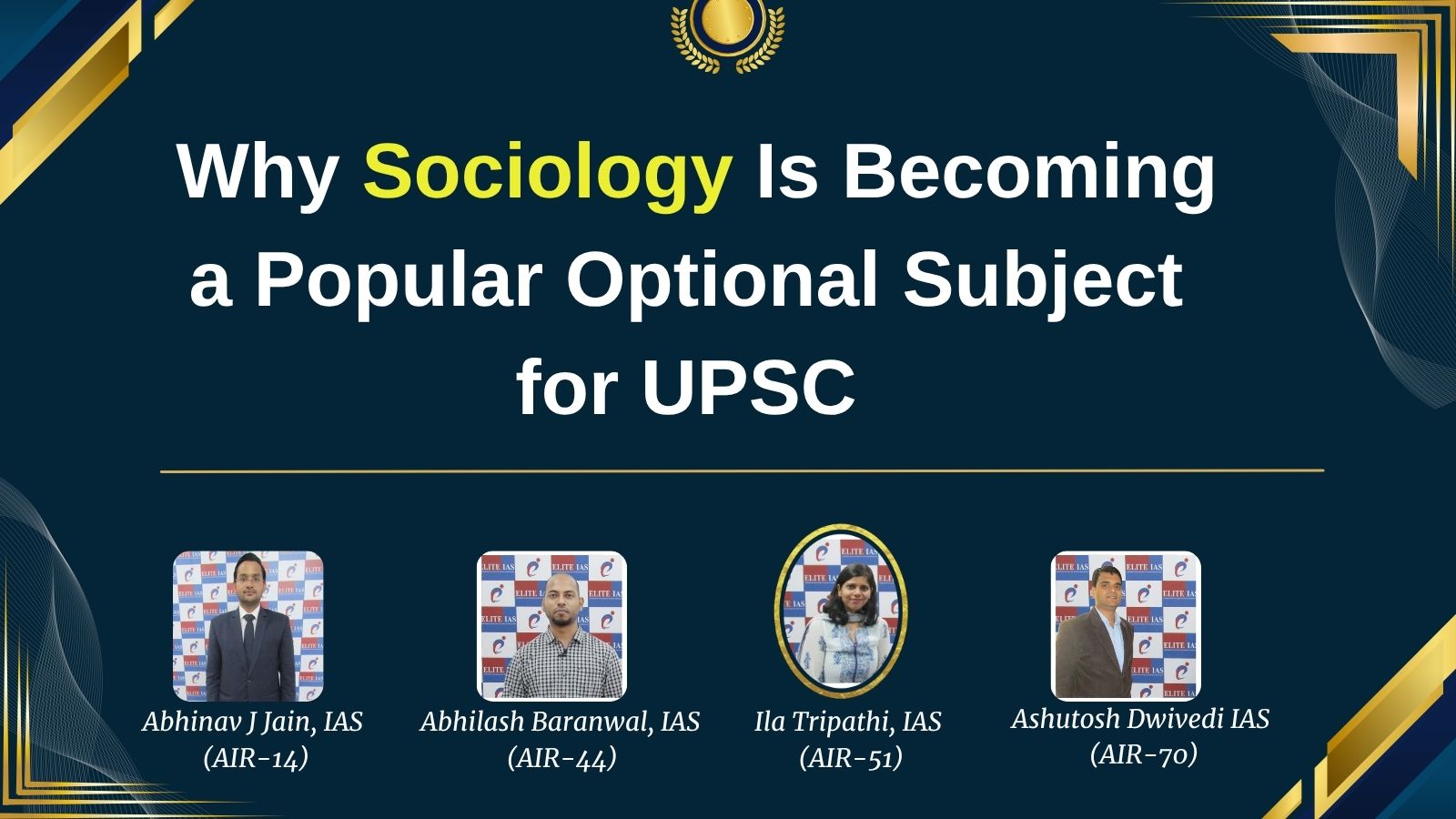
In recent years, Sociology has steadily emerged as one of the most preferred optional subjects among UPSC aspirants. Earlier, many candidates chose their optional subjects based on academic background or popular opinion. Today, however, aspirants are approaching the Civil Services Examination with far greater strategic awareness. They carefully analyse factors such as syllabus length, overlap with General Studies, conceptual clarity, and scoring potential before making their decision.
This strategic shift has led many serious aspirants to explore institutions that provide sociology optional coaching online along with structured preparation and mentorship. As the competition in the Civil Services Examination continues to intensify, aspirants increasingly seek subjects that allow them to develop analytical depth while maintaining manageable preparation timelines.
Another reason behind the growing preference for Sociology is the availability of experienced guidance. At Elite IAS, Sociology Optional is mentored by Bibhash Sharma. Many aspirants preparing through established IAS coaching in Delhi environments often find that structured Sociology preparation provides both academic clarity and exam-oriented strategy.
The Overlap Between Sociology and General Studies
One of the strongest reasons behind Sociology’s popularity is its significant overlap with the General Studies papers of the UPSC examination. This overlap allows aspirants to prepare efficiently while strengthening their conceptual understanding across multiple papers.
For instance, Sociology directly contributes to GS Paper I, particularly in topics related to Indian society, social change, diversity, urbanization, and issues like caste, gender, and communalism. Many themes that appear in the GS syllabus are deeply rooted in sociological concepts.
Similarly, Sociology indirectly supports GS Paper IV (Ethics) by helping aspirants understand social values, norms, and moral frameworks within societies. Concepts like social responsibility, collective conscience, and institutional ethics often enrich answers in the ethics paper.
Another major advantage appears in Essay writing. Many UPSC essays revolve around social themes such as inequality, social justice, education, development, and cultural transformation. Sociology provides the theoretical framework needed to approach these topics with depth, examples, and structured arguments.
Sociology Helps Develop Analytical Thinking
Unlike subjects that rely heavily on factual memorization, Sociology encourages aspirants to think critically about social processes and human behaviour. It trains candidates to examine how societies function and how various institutions interact with each other.
Through sociological study, aspirants begin to understand complex issues such as social stratification, caste dynamics, gender relations, and economic inequality. They also explore how institutions like family, religion, education, and politics shape social structures.
This analytical orientation becomes extremely valuable in the Civil Services Examination, where answers are expected to demonstrate both conceptual clarity and real-world understanding. Sociological perspectives help aspirants analyse contemporary issues such as migration, globalization, rural transformation, and technological change.
More importantly, Sociology encourages aspirants to view society from multiple perspectives. This ability to connect theory with real-life examples significantly improves answer quality and analytical depth.
The Scientific Yet Accessible Nature of Sociology
Another reason Sociology attracts UPSC aspirants is its balance between theoretical depth and conceptual accessibility. While the subject introduces aspirants to important sociological thinkers and theories, it does not require complex mathematical calculations or technical frameworks.
The subject is built around understanding social behaviour, institutions, and patterns of interaction. As a result, aspirants from diverse academic backgrounds - including engineering, commerce, science, and humanities - can grasp the subject without facing steep conceptual barriers.
Moreover, Sociology encourages structured thinking rather than rote memorization. Once aspirants understand core sociological concepts, they can apply them to a wide range of topics, from rural development to urban challenges.
Sociology’s Relevance to Contemporary Issues
Another important reason behind the increasing popularity of Sociology among UPSC aspirants is its strong connection with contemporary social realities. The subject equips candidates with conceptual tools to understand the deeper causes behind many of the challenges discussed in newspapers, policy debates, and government reports.
For instance, issues such as social inequality, migration, urbanization, gender justice, and identity politics are not merely current affairs topics; they are sociological processes rooted in historical and institutional structures. Sociology provides frameworks to analyse why inequalities persist, how societies adapt to modernization, and how communities respond to economic and cultural changes.
This relevance becomes particularly useful for UPSC aspirants because many examination questions now require analytical interpretation rather than simple factual recall. When candidates understand concepts like social stratification, modernization, or social mobility, they can connect theory with contemporary developments such as rural transformation, urban expansion, or the rise of digital communities.
As a result, Sociology allows aspirants to interpret current affairs through a structured intellectual lens rather than approaching issues in a fragmented way.
Shorter and More Manageable Syllabus
Another factor that makes Sociology attractive to many aspirants is its relatively concise and manageable syllabus. Compared with some optional subjects that require extensive technical study or large volumes of information, Sociology focuses on conceptual clarity and structured understanding.
The syllabus is broadly divided into two parts. The first paper introduces fundamental sociological thinkers, theories, and concepts, while the second paper focuses on Indian society, including topics such as caste, social movements, rural transformation, and development processes.
For candidates balancing General Studies, essay preparation, and optional subject study, this manageable structure often becomes a significant advantage.
High Scoring Potential with Smart Preparation
Sociology has also gained attention because it offers strong scoring potential when prepared strategically. The subject rewards analytical answers that combine sociological theory with real-world examples.
For example, references to thinkers like Émile Durkheim, Max Weber, and Karl Marx can enrich answers when used appropriately to explain social processes. Similarly, incorporating contemporary case studies, government initiatives, and empirical observations helps demonstrate a deeper understanding of society.
The key lies in presenting answers that integrate sociological concepts with practical illustrations. When aspirants develop this ability, their responses become both academically grounded and relevant to contemporary realities.
Such structured answers often stand out in evaluation because they demonstrate clarity of thought, theoretical awareness, and contextual understanding.
Importance of Practice and Test Series
Even with strong conceptual understanding, consistent practice remains essential for scoring well in Sociology optional. UPSC answers must be written within strict time limits while maintaining clarity, structure, and analytical depth.
This is why many aspirants rely on a structured sociology test series to refine their preparation. Regular answer-writing practice helps candidates learn how to frame sociological arguments, incorporate thinkers’ perspectives, and structure answers effectively within limited time.
A well-designed test series also exposes aspirants to diverse question patterns, enabling them to understand how sociological concepts can be applied to different types of questions. Over time, this process strengthens both writing speed and conceptual application.
Sociology provides a unique combination of theoretical insight and practical relevance. It strengthens analytical thinking, enhances answer-writing depth, and helps aspirants interpret complex social realities. For many UPSC candidates, this combination makes Sociology not only an academically enriching subject but also a strategically sound choice in their journey toward the Civil Services.