Complete CAT 2026 Roadmap: Study Plan, Strategy & Preparation Tips
Prepare smartly for CAT 2026 with a complete roadmap covering study plans, preparation strategy, syllabus, mock tests, time management, and expert tips for a high percentile.
For serious aspirants who wish to crack CAT 2026 and get into a top MBA college like the IIMs, there is a mix of motivation, discipline, and strategic preparation. With the exam in late November 2026, candidates have approximately six months to either maximise their percentile or lose valuable opportunities through inconsistency and poor planning. From Quantitative Aptitude and VARC to DILR, there is a lot to cover, and the perfect CAT 2026 strategy is something that will help you sail through this exam. This comprehensive guide can prove to be the structured CAT 2026 roadmap that can help you prepare a smart study plan, go through consistent mock practice, and work on time management skills that are very significant to achieve a high percentile in this exam.
What Is CAT 2026 Exam Pattern
To give an edge to CAT 2026 preparation, you must understand what you are preparing for. CAT is a 2-hour computer-based test divided into three sections—Verbal Ability & Reading Comprehension (VARC), Data Interpretation & Logical Reasoning (DILR), and Quantitative Aptitude (QA). Each section carries a 40-minute slot with no scope to switch between them during the allotted time. The total marks count for 198 with a +3/-1 marking scheme for MCQs and no negative marking for TITA (Type In The Answer) questions.
The TITA questions ask the aspirants to type an answer without options, which makes them strategic goldmines. Attempting them smartly with no penalty risk can automatically boost your sectional scores.
How To Prepare For CAT 2026
The most common preparation mistake is jumping into mock tests or dense topic chapters without first looking into personal strengths and weaknesses. What the CAT toppers prefer is to spend two weeks attempting CAT mock tests, attempt CAT last year question paper, reviewing section by section, and identifying three to four areas where there is a possibility of you losing maximum marks. This self-assessment would be the backbone of your entire CAT 2026 strategy.
Month-Wise CAT 2026 Study Plan
To clear the CAT exam, you can’t be the one who relies on guesswork and follows the principle “I’ll start properly next week”. Because this is a trap that derails thousands of aspirants every year. Here’s a practical month-wise CAT 2026 study plan prepared for someone starting in June 2026:
June 2026–Foundation Building
In the initial months of your preparation, cover arithmetic basics (percentages, ratios, averages, time-speed-distance), grammar basics for VARC, and set introduction for DILR. Invest 3-4 hours on weekdays and 5-6 hours on weekends. Also, opt for two editorials from The Hindu or The Economic Times every morning to boost current affairs.
July 2026–Core Concept Mastery
Deep dive into Number System, Algebra, and Geometry for QA. Start practicing Reading Comprehension passage types–descriptive, argumentative, abstract. Solve 2-3 DILR sets daily. Sit for your first full-length mock at the end of the month.
August 2026–Speed & Accuracy Drills
Focus intensely on TITA problem-solving, Verbal Reasoning (Parajumbles, Parasummaries, Odd Sentence Out), and advanced DILR types such as networks and games. From this month onwards, take two mocks per week and analyse every attempt intricately.
September 2026—Intense Mock Practice
It’s time to shift your CAT 2026 preparation towards intense mock test practice. Go for three mocks per week. Stop learning new topics; work diligently on the weak areas using targeted practice. Work on a sectional time management strategy that will help you better understand which questions to skip, attempt, or guess intelligently.
October-November 2026–Revision Time
Go for the CAT previous years’ question papers under timed conditions. This will help you identify high-weightage concepts, repeated topics, and the marking scheme, effective to crack the CAT exam in the first attempt.
Section-Wise Strategy For CAT 2027
For VARC, practicing through the reading comprehension alone makes 24 of 34 questions in this section. Here, you need to train yourself to read fast, and that too accurately, such that you get the gist of the author’s core argument. Also, to gain mastery in Verbal Reasoning, you need to practice patterns as many times as you can.
For DILR, the key is to score higher in the set selection. In the actual exam, you will have to solve 4-5 sets across 40 minutes. The best strategy in this context is to spend 30-60 seconds understanding what exactly the question demands.
For QA, a 99th percentile does not require attempting each and every question. Instead, it is required to pick the right questions. Practice all possible arithmetic and algebra questions, through which you can develop pattern recognition for tricky questions, and be willing to move on within 60-90 seconds if a problem doesn’t click.
Best CAT Books to Pick in 2026
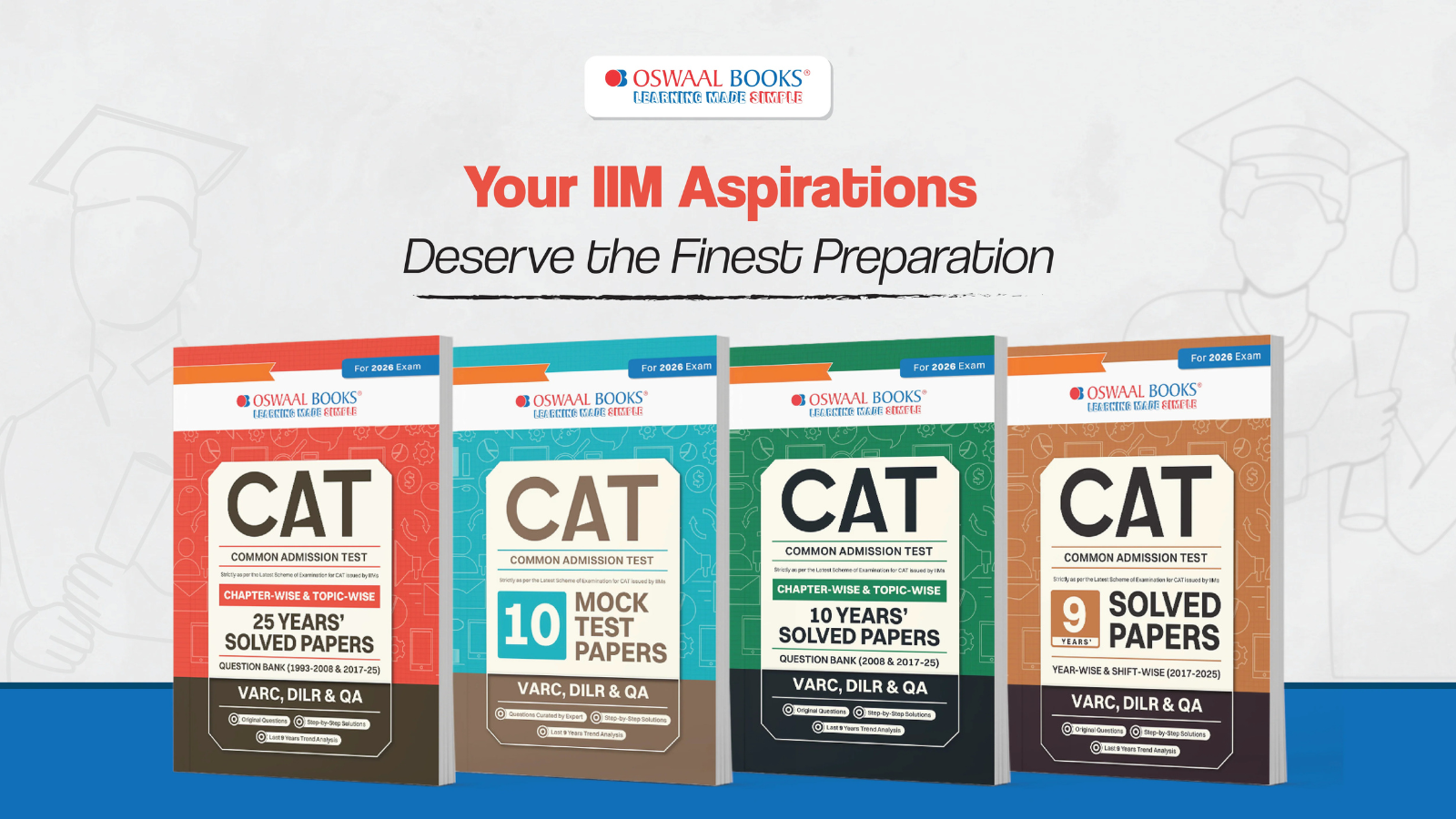
While picking the best CAT books for 2026 exam, you must keep in mind that no single book is sufficient to crack the examination. The ideal preparation strategy should involve a combination of concept-building books, sectional practice material, mock tests, and CAT previous years question papers analysis. To give aspirants a one-step solution, Oswaal comes with a CAT 2026 preparation book series including 25 Years’ Chapter-wise & Topic-wise Solved Papers, with the following listed features:
- 25 Years of Solved CAT Questions (1993-2008 & 2017-2026): They are arranged chapter and topic-wise across all three sections, so the practice is targeted, never scattered.
- 2400+ Practice Questions: That cover every important topic with the depth this exam demands, because surface-level preparation will not help you achieve a high percentile.
- 3 Sample Question Papers: Designed to give students a real-exam feel before the final CAT exam.
- Effective Revision Tools: Revision notes, mind maps, mnemonics are perfect for concept understanding and last-minute revision.
- Exam Insights, Tips & Shortcuts: The kind of strategic tips you’ll need that not just help you work harder, but also work smarter.
Concluding Words
CAT 2026 is not just a test of intelligence — it is a test of preparation quality, consistency, and smart strategy. The aspirants who succeed are rarely those who studied the most hours, but those who studied with purpose, analysed their performance honestly, and walked into the exam knowing exactly how to manage their time and energy. Start your preparation with a clear roadmap, invest in the right resources, including structured books like the Oswaal CAT series, build your mock-taking discipline early, and trust the process. Six months of focused, strategic effort is more than enough to put you on the IIM shortlist.
CAT 2026 — FAQs
When will CAT 2026 be conducted?
CAT 2026 is expected to take place in the month of November 2026, most likely on Sunday. You must keep an eye on the official notification from IIM, typically released in July-August.
How many hours of daily preparation are needed to crack CAT?
If you have a six-month preparation window, you must spend 4-5 hours; this is more than enough. Working professionals can manage with 2-3 focused hours on weekdays and 6-8 hours on weekends.
How many mock tests should I take before CAT 2026?
Ideally, between 40 and 60 full-length mocks across your preparation journey. You can start with one mock per week from month 2, gear up to 3 per week by September, and then maintaining the rhythm in October-November is highly recommended.
What is a good score to target for the top IIMs?
For IIM Ahmedabad, Bangalore, and Calcutta — collectively called the ABC IIMs — you typically need 99th percentile or above in the overall score, along with competitive sectional percentiles (usually above 90 per section). For the newer IIMs, a 95–98 percentile range is generally competitive.
Which section should I start preparing first?
Begin with Quantitative Aptitude since it has the largest concept base and requires the most time to build fluency. Simultaneously keep reading editorials daily for VARC. DILR can be built progressively through set practice once you have a foundational understanding of the other two sections.
Are Oswaal CAT books suitable for beginners?
Yes, Oswaal's CAT series is well-suited for both beginners and advanced learners. The topic-wise structure allows beginners to build chapter by chapter, while the previous years' papers and trend analysis make it equally valuable for aspirants who are revisiting material in the final months of preparation.