IPMAT Coaching Reviews: How to Choose the Right Institute
Looking for the right IPMAT coaching institute? Learn how to evaluate IPMAT coaching reviews, ratings, student feedback, faculty, mock tests, mentorship, course quality, and other evidence before choosing an IPMAT coaching institute for your preparation.
Hello Aspirants!
Choosing an IPMAT coaching institute can be difficult when every platform claims to offer experienced faculty, quality study material, regular mocks, mentorship, and strong results. Student reviews can make the decision easier, but only when you know how to read them.
A 4.8/5 rating may look impressive, but it does not tell you whether the reviews are recent, whether they belong to the course you are planning to join, or whether students actually liked the teaching, mock tests, doubt support, and mentorship.
Instead of choosing an institute based on one rating or one testimonial, IPMAT aspirants should compare different types of evidence and look for recurring patterns.
Why You Should Not Depend Only on the Rating
A rating gives you a quick overview, but it does not explain the actual student experience.
For example, an institute can have a high Google rating, while students on Reddit or other discussion platforms may raise concerns about a particular course, faculty member, centre, or support system.
The reverse can also happen. A few negative comments do not automatically mean that an institute provides a poor learning experience.
The more useful question is:
What do multiple sources say about the specific part of the coaching experience that matters to you?
This is why review count, review details, recency, course type, and recurring feedback should be considered together.
AcademyCheck's recent IPMAT review research, for example, considered student ratings and review counts along with recurring positive and negative feedback and student experience videos rather than relying only on a single rating.
What Makes an IPMAT Coaching Review Useful?
Not every review gives you enough information to make a decision. A useful review usually tells you something specific about the student's experience.
1. Look for Specific Details
Compare these two reviews:
“Great coaching institute. Highly recommended.”
and:
“I joined the online IPMAT batch and found the Quant classes useful, but I felt the doubt-solving response was slower than expected.”
The second review gives you something you can actually investigate.
Look for comments about:
Faculty and teaching style
Quality of study material
Mock tests and test analysis
Doubt-solving
Mentorship
Live and recorded classes
Interview preparation
Course duration and access
Overall workload
The more specific the review is, the easier it is to compare it with other evidence.
2. Check When the Review Was Written
IPMAT courses change regularly.
Faculty members can change. Mock-test platforms can be updated. Course structures and fees can change. An institute that offered a particular feature two years ago may not offer the same thing today.
Therefore, a review from 2023 should not automatically be treated as evidence about a 2027 course.
Always check:
Review date
Course or batch
Online or offline mode
Exam year
Centre, if applicable
3. Check Whether the Review Matches Your Course
This is especially important for institutes that offer multiple programs.
A student reviewing an offline classroom program may have a completely different experience from someone using an online self-paced course.
For example, IMS currently offers different IPMAT preparation formats, including online and classroom programs. Its current online IPMAT 2027 program lists 115–165 concept and practice sessions, 96 topic-wise tests, 190 full-length tests, 10,000+ questions with video solutions, and eight one-on-one mentoring sessions.
If you are considering that program, reviews about an unrelated IMS centre or an older course should be treated as supporting information rather than direct evidence about your experience.
Look at More Than One Review Platform
Different platforms can reveal different parts of the student experience.
Source | What You Can Learn |
|---|---|
Google Reviews | General experience, centre-specific feedback, and recurring complaints |
Trustpilot | Customer feedback and written experiences where available |
Reddit/forums | Detailed individual experiences and discussions |
YouTube | Student interviews, preparation journeys, and teaching samples |
Official Website | Current course structure, faculty, mocks, and institute-reported claims |
Results Pages | Published result and selection claims |
No single source should be treated as perfect.
Google reviews can be useful for identifying recurring patterns, but they may include students from different courses or centres. Reddit can provide detailed experiences, but individual comments are not independently verified. Official websites are useful for current course information, but claims made by an institute should be identified as provider-reported.
Example: How to Research SuperGrads
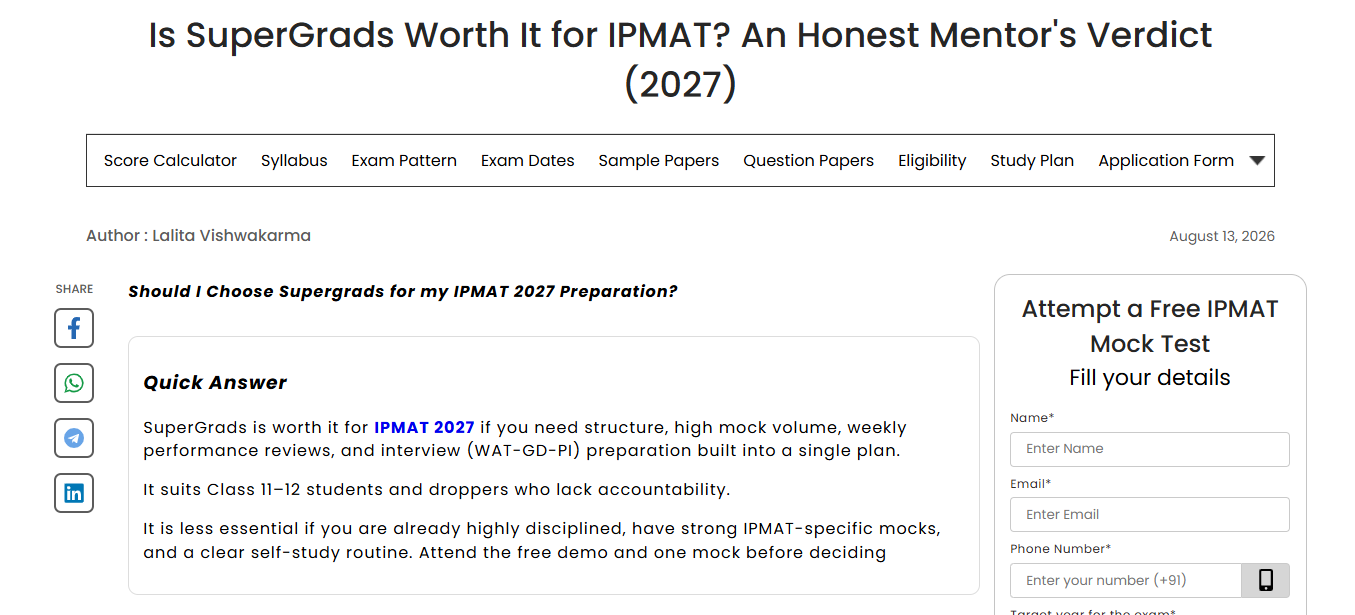
SuperGrads is a useful example of why students should look beyond the number of mocks advertised by an institute. Its current IPMAT preparation information includes live and recorded classes, mentorship, doubt support, and interview preparation, while its test-series information lists separate tests for IPMAT Indore, Rohtak, and JIPMAT. Click here to check SuperGrads courses, coaching, mocks, etc.
When checking SuperGrads reviews, look specifically at:
Mock quality: Do students find the tests relevant to the actual exam?
Test analysis: Are solutions and performance reports actually useful?
Platform experience: Do students mention technical issues or difficulties using the test platform?
Learning value: Do reviews explain how the mocks helped students identify weak areas?
What this tells you:
A large mock-test library is useful, but the number alone does not tell you whether the tests are actually helping students prepare.
Teaching Evidence
IPMAT 2026: Mock-Test Proven VARC Notes ✍️ | Make Them the Right Way 🎯 | Toppers Strategy 📝
Your next breakthrough in prep starts here | IPMAT 2026 SURESHOT Selection Batch
Click here to check the Fees, Results, Facilities, and more videos on AcademyCheck: SuperGrads by Toprankers
Example: How to Research IMS
IMS is a good example of why the context behind a review matters. The institute offers different IPMAT preparation formats and centres, so an overall rating may combine experiences from students who used different programs.
When checking IMS reviews, look for:
Course: Was the student reviewing the online IPMAT program or a classroom batch?
Centre: If the student studied offline, which IMS centre were they referring to?
Faculty: Does the review mention a specific teacher or subject?
Program: Was the experience actually related to IPMAT preparation?
The current IMS IPMAT 2027 online program also lists concept and practice sessions, masterclasses, mentoring, practice questions, and mock tests. Click here to check IMS courses, coaching, mocks, etc.
What this tells you:
A review becomes much more useful when the student's course, mode, and learning environment match the one you are considering.
Teaching Evidence
Click here to check the Fees, Results, Facilities, and more videos on AcademyCheck: IMS

Example: How to Research LPT
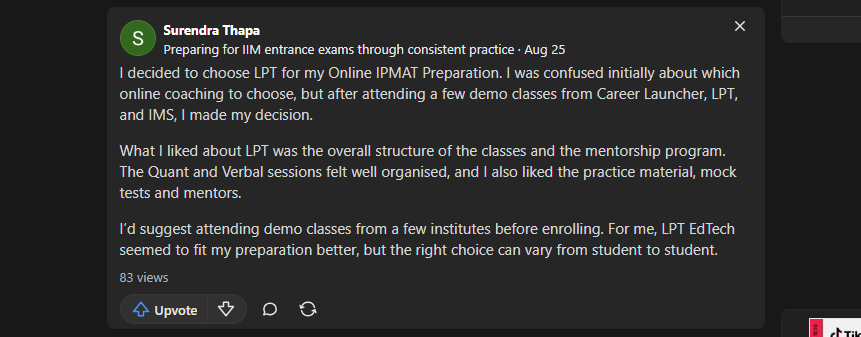
LPT demonstrates why students should look at review volume and review specificity together. A high rating may look convincing, but a smaller collection of reviews may not provide enough IPMAT-specific evidence on its own.
When checking LPT reviews, look for:
IPMAT relevance: Does the review actually discuss IPMAT preparation?
Specificity: Does the student mention faculty, mocks, classes, or support?
Recency: Is the feedback from a current or recent batch?
Consistency: Do several students mention similar strengths or problems?
LPT's current course information can then be used to cross-check what the institute currently offers in terms of classes, study material, practice, and testing. Click here to check LPT courses, coaching, mocks, etc.
What this tells you:
A high rating is a useful starting point, but rating + review count + specific feedback gives you a more meaningful picture.
Teaching Evidence
Click here to check the Fees, Results, Facilities, and more videos on AcademyCheck: LPT EdTech
Example: How to Research PWLive
PWLive is useful for showing how students should handle a large volume of reviews. A large review pool gives you more experiences to examine, but it can also contain feedback about different programs and subjects.
When checking PWLive reviews, pay attention to:
Online classes: What do students say about live and recorded sessions?
Mocks: Are the tests considered useful and appropriately difficult?
Doubt support: Are students satisfied with how questions are handled?
Recurring feedback: Do similar comments appear across different platforms?
These comments can then be compared with PW's current IPMAT course information, including its classes, practice questions, mocks, and interview preparation. Click here to check PWLive courses, coaching, mocks, etc.
What this tells you:
A large number of reviews gives you more evidence to investigate, but it does not automatically make the evidence more useful.
Teaching Evidence
Ratio & Proportion Ep. 01 🔥 | IPMAT Power Batch FREE Demo Lecture | Quants | IPMAT 2027 Preparation
IPMAT 2026 Quants LIVE Mock Analysis | Score Booster Session
Venn Diagrams | DEMO LEC 01 | IPMAT 2025 CRASH COURSE | IPMAT 2025 PREPARATION
Click here to check the Fees, Results, Facilities, and more videos on AcademyCheck: PWLive (Physics Wallah)

Example: How to Research IPM Careers
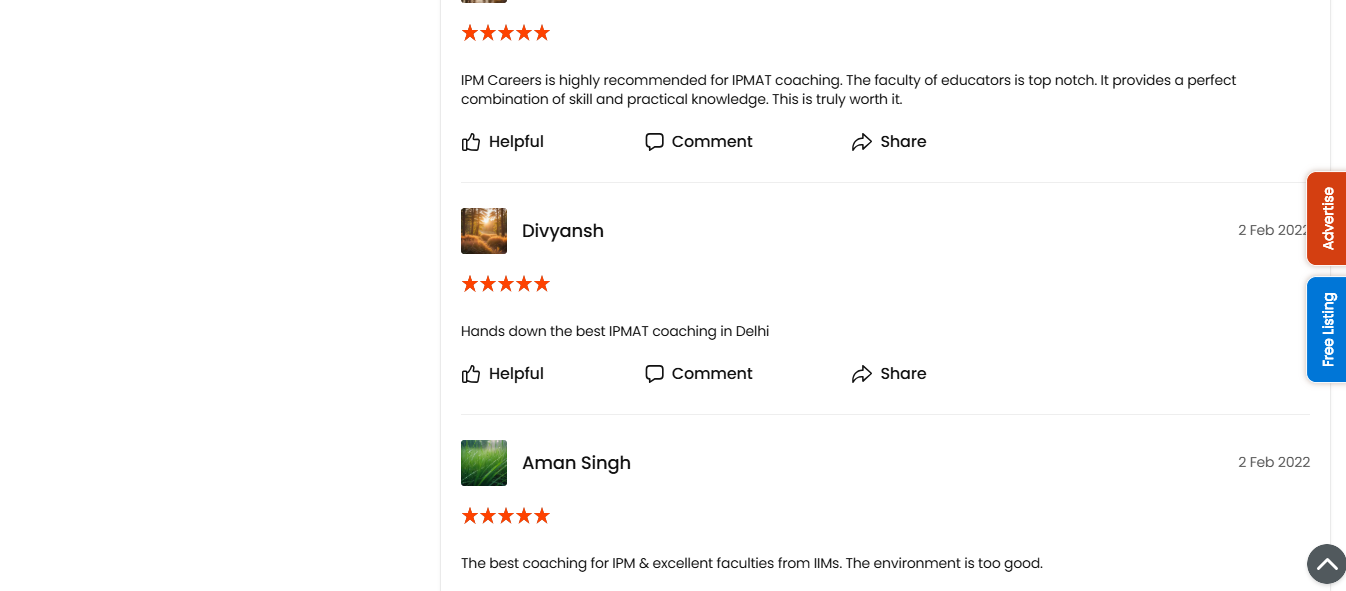
IPM Careers is a useful example of how to handle negative or mixed reviews. Instead of treating one criticism as proof that an institute has a widespread problem, students should investigate whether the same concern appears elsewhere.
When checking IPM Careers reviews, ask:
Is the complaint recent?
Was it about the same course you are considering?
Do other students report the same issue?
Does the current course information address the concern?
Has the institute changed its system since the review was posted?
Current IPM Careers information can also be checked against student discussions about its content, support, and preparation structure. Click here to check IPM Careers courses, coaching, mocks, etc.
What this tells you:
A negative review is best treated as a question to investigate, not an automatic reason to reject an institute.
Teaching Evidence
Click here to check the Fees, Results, Facilities, and more videos on AcademyCheck: IPM Careers
How to Identify Review Red Flags
Before trusting a review, look for warning signs.
Generic praise: Reviews such as “best coaching” or “excellent teachers” provide very little information.
No course information: If the review does not mention whether the student joined an online course, classroom batch, crash course, or test series, its relevance may be unclear.
Very old reviews: Older reviews may describe a course, faculty team, or platform that has since changed.
One-sided result stories: A testimonial about getting into an IIM can demonstrate one student's outcome, but it does not automatically tell you how the average student experienced the course.
Repeated wording: If many reviews use almost identical language, students may want to investigate further rather than treating every review as independent evidence.
Unverified claims: A student saying “this institute has the best faculty in India” is an opinion, not a measurable fact. Similarly, an institute claiming a large number of selections should be treated as a provider-reported result unless supporting evidence is available.
Use Negative Reviews as Questions, Not Conclusions: Negative reviews can be useful, but they should be investigated carefully. Suppose several recent students complain about slow doubt support.
Instead of immediately deciding not to join, ask:
Are they talking about the same course?
Are the complaints recent?
Do students on other platforms mention the same issue?
Has the institute changed its support system?
Can the institute explain how doubt-solving currently works?
A recurring issue across multiple recent and independent sources is more useful than one isolated complaint.
What Should You Verify Before Paying?
Before purchasing an IPMAT coaching course, create a simple checklist.
Area | What to Verify |
|---|---|
Faculty | Who will actually teach your batch? |
Classes | Live, recorded, or both? |
Study Material | What is included? |
Mocks | How many full-length, sectional, and topic tests? |
Test Analysis | Are detailed solutions and performance reports provided? |
Doubt Support | How are academic doubts handled? |
Mentorship | Is there actual one-to-one guidance? |
Interview Prep | Is PI/WAT preparation included? |
Results | Can important result claims be verified? |
Reviews | Are there recurring comments across different platforms? |
Fees | What exactly is included in the advertised price? |
Validity | When does course/test access expire? |
Final Takeaway
IPMAT coaching reviews can be extremely useful, but only when you treat them as evidence rather than as a final verdict.
Do not choose an institute simply because it has the highest rating or the largest number of reviews.
Instead, compare specific student experiences, review recency, course type, recurring feedback, current course features, faculty information, mock-test systems, and publicly available proof.
Most importantly, separate three things:
What the institute claims.
What individual students say.
What you can independently verify.
An institute may have excellent reviews but still not match your learning style. Another may have mixed reviews but offer the exact teaching format, mock system, and mentorship structure you need.
The right IPMAT coaching institute is therefore not necessarily the one with the highest rating. It is the one whose teaching, testing, support, and preparation system match your own needs, and whose important claims you can verify before paying.