How to Prepare for CAT 2026 in 6 Months? Tips & Strategy
Crack CAT 2026 in just 6 months! Follow this smart study plan with expert tips, mock test strategy, and time management techniques for a high percentile.
-1774245171828582.png)
Preparing for the Common Admission Test (CAT) in just 6 months seems daunting at first, but it is absolutely achievable. Just like you, many aspirants have a short span of time to prepare, yet have the grit to crack the CAT exam. With the right preparation strategy, focused practice, and a clear plan, they turn this challenge into a success story—and so can you.
The key lies not in the long hours of study, but in how effectively you use your time to cover the entire syllabus of the CAT exam. If you are willing to commit to a clear plan, practice regularly, and continuously analyze your performance, these six months can become a turning point in your career, too.
What is the CAT Exam Structure 2026?
Before starting your preparation, it is significant to understand the structure of the CAT exam. The exam looks for the balance of knowledge, aptitude, speed, and decision-making under pressure.
Section | Key Skills Tested |
VARC (Verbal Ability & Reading Comprehension) | Reading skills, comprehension, critical reasoning |
DILR (Data Interpretation & Logical Reasoning) | Analytical thinking, data analysis, logical structuring |
QA (Quantitative Ability) | Mathematical concepts, problem-solving, speed |
Pro Tip: The exam is time-bound with sectional limits, which means you need to be equally prepared for all the sections. Your focus must be on accuracy, time management, and smart question selection.
What is the CAT 2026 Exam Pattern, Marking Scheme, and Duration?
Picking the right books for CAT 2026 is important, but equally important is understanding the exam pattern and structure. Without clarity on how the Common Admission Test is designed, even the best resources may not give you the desired results. Here’s the exam pattern we are sharing with you, do have a look:
Category | Details |
Total Exam Duration | 120 minutes (2 hours), divided equally across three sections |
Sectional Time Limit | 40 minutes allotted to each section |
Total Number of Questions | 66-68 questions (varies slightly each year) |
Marking Scheme | +3 marks awarded for every correct answer (both MCQ & TITA) |
Negative Marking | -1 mark deducted for every incorrect MCQ response |
No Negative Marking | No penalty for incorrect TITA answers |
Mode of Examination | Computer-based test (CBT) conducted online |
Difficulty Level | Moderate to high, with a strong focus on application and reasoning |
Points To Remember Before Giving the CAT 2026 Exam
Switching between the sections isn’t allowed.
Each section has a strict time limit ( 40 minutes), and it auto-submits once time is over.
One cannot revisit a section once its time is up.
Manage time wisely; there's no need to get stuck on one question.
Use the on-screen calculator smartly (especially for QA & DILR).
Attempt easy questions first to maximise score.
Negative marking applies for MCQs (−1 for wrong answers).
No negative marking for TITA (Type In The Answer) questions.
What Is The Best CAT 6-Month Preparation Strategy To Score 99+ Percentile?
To take your preparation for the CAT exam to the next level, we are sharing a crystal-clear, stage-wise plan. This structure ensures a balanced focus on Quant, DILR, and VARC, along with gradual improvement in daily practice.
Stage | Quant Focus | DILR Focus | VARC Focus | Daily Practice Target |
Stage 1 | Percentages, Ratios, Averages | Tables, Bar Graphs | RC Basics + Para Jumbles | 2 RC + 2 VA + 2 DILR sets |
Stage 2 | Profit & Loss, Alligation | Line Charts, Caselets | RC + Summary Questions | 2 RC + 2 VA + 2 DILR sets |
Stage 3 | Time, Speed & Distance + Revision | Advanced DI Sets | RC + Odd One Out | 3 RC + 3 VA + 3 DILR sets |
Stage 4 | Time & Work | Arrangements (Linear/Circular) | RC + Para Completion | 3 RC + 3 VA + 3 DILR sets |
Stage 5 | Simple & Compound Interest | Blood Relations, Basic LR | RC + Summary Practice | 3 RC + 3 VA + 3 DILR sets |
Stage 6 | Arithmetic Full Revision | Games & Tournaments | Mixed RC Practice | 4 RC + 3 VA + 4 DILR sets |
Stage 7 | Arithmetic PYQs | Mixed DI + LR Sets | RC + Grammar Basics | 4 RC + 3 VA + 4 DILR sets |
Stage 8 | Linear & Quadratic Equations | Matrix, Constraints-Based Sets | RC + Para Jumbles | 4 RC + 3 VA + 4 DILR sets |
Stage 10 | AP, GP | Caselets + Graphs | RC + VA Mix | 4 RC + 3 VA + 4 DILR sets |
Stage 11 | Polynomials, Modulus | Selection-Based Puzzle Sets | RC Intensive Practice | 4 RC + 3 VA + 4 DILR sets |
Stage 12 | Functions, Logarithms | Tough Logical Sets | VA Focus + RC | 4 RC + 3 VA + 4 DILR sets |
Stage 13 | Triangles | DI + LR Combo Sets | RC + Summary | 4 RC + 3 VA + 5 DILR sets |
Stage 14 | Circles | Venn Diagram, Set Theory | RC + Para Completion | 5 RC + 3 VA + 5 DILR sets |
Stage 15 | Quadrilaterals | Selection-Based Sets | RC + Summary | 5 RC + 3 VA + 5 DILR sets |
Stage 16 | Mensuration | Mixed Puzzle Sets | RC + Odd Sentence | 5 RC + 3 VA + 5 DILR sets |
Stage 17 | Number System (Basics) | Mixed DILR Sets | RC + VA | 5 RC + 3 VA + 5 DILR sets |
Stage 18 | Number System (Advanced) | CAT-Level DILR Sets | RC Intensive | 5 RC + 3 VA + 5 DILR sets |
Stage 19 | Permutation & Combination, Probability | Variety DILR Sets | VA Practice + RC | 5 RC + 3 VA + 5 DILR sets |
Stage 20 | Logs, Set Theory + Revision | Weak Area DILR Sets | Mixed Practice | 5 RC + 3 VA + 5 DILR sets |
Stage 21 | Arithmetic Revision | DILR Practice Sets | RC + VA | 5 RC + 3 VA + 5 DILR sets |
Stage 22 | Algebra Revision | DILR Sets | RC + VA | 5 RC + 3 VA + 5 DILR sets |
Stage 23 | Geometry Revision | Mock-Based Weak Areas | RC + VA | 5 RC + 3 VA + 5 DILR sets |
Stage 24 | Mixed Quant Practice | Mixed DILR Sets | RC + VA | 5 RC + 3 VA + 5 DILR sets |
Stage 25 | Light Revision | Easy DILR Sets | RC + VA (Light) | 3 RC + 2 VA + 2 DILR sets |
Stage 26 | Final Revision & Strategy | 1–2 Easy Sets Daily | Light RC + VA | 2 RC + 2 VA + 1 DILR set |
Why Mock Tests Are the Game-Changer for CAT 2026 Success
Consistent mock practice is what separates 90 percentile scorers from 99+ achievers. Solving CAT mock test papers can boost your score, as they give:
Build Real-Exam Temperament: Mock test replicates the exact environment of CAT 2026, helping the aspirants get comfortable with exam pressure and timing.
Improve Time-Management: It helps to get into the strict practice of 40-minute sectional limits without panicking.
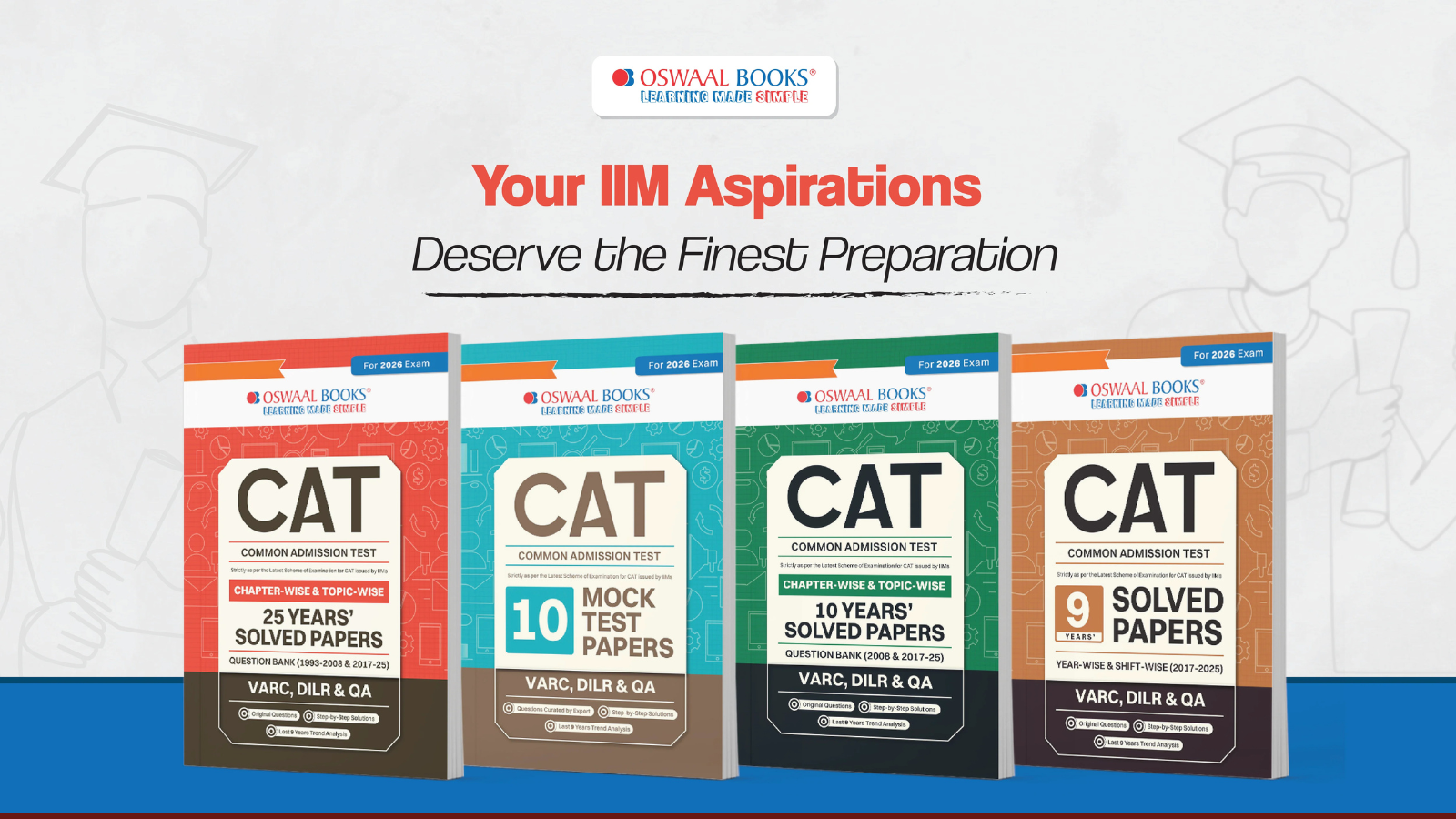
Boost Speed & Accuracy: Regularly solving Oswaal CAT 25 Years Previous Solved Question Papers improves how quickly and correctly you solve questions.
Highlight Strengths & Weaknesses: Candidates can easily identify which section (VARC, DILR, QA) needs more focus.
Do Performance Analysis: CAT mock test papers help understand mistakes to avoid them in the future.
Sharpen Decision Making: Improves the ability to choose the right questions under exam pressure.
Adapt to Difficulty Levels: Exposure to easy, moderate, and tough mocks prepares the candidates to score well in the CAT exam 2026.
Reduce Exam Anxiety: Familiarity with the test format boosts confidence before exam day.
Common CAT 2026 Mistakes That Cost You Top B-Schools
Here are some common mistakes that CAT aspirants should avoid to achieve a 99+ percentile:
Ignoring the Right Study Material: Picking up random learning resources instead of trusted CAT 2026 books can weaken the fundamentals and waste a lot of time.
Using Too Many Books: Constantly switching between multiple cat books for 2026 exam leads to confusion and a lack of depth.
Weak Conceptual Foundation: Skipping basics and not using proper CAT 2026 preparation books can result in poor accuracy in tougher questions.
Starting Mock Tests Too Late: Delaying mocks means missing out on strategy building and real exam exposure.
Poor Time Management: Spending too long on one question can cost you several easy attempts.
Ignoring Previous Year Questions: Not practicing PYQs means missing real exam trends and difficulty levels.
Not Revising Regularly: Forgetting key formulas and concepts due to a lack of revision can be costly.
No Sectional Strategy: Treating all sections the same without a clear plan reduces efficiency.
Learning New Topics at the Last Moment: This creates confusion instead of boosting confidence.
Final Thoughts
Preparing for CAT in six months is not about studying endlessly—it is about studying smartly. With a clear plan, consistent practice, and the right resources, you can significantly improve your performance.
Nothing seems impossible if you are driven by your dreams, have faith in your hard work, and stay consistent with your efforts. If you remain focused and committed throughout these six months, cracking the CAT 2026 and securing admission into a top B-school is well within your reach.
FAQs - CAT 2026
1. Is 6 months enough to prepare for CAT 2026?
Yes, 6 months are sufficient if you follow a structured plan, practice consistently, and focus on mock tests and analysis. Many aspirants have achieved 95–99+ percentile with disciplined preparation in this timeframe.
2. How many mock tests should I take for CAT 2026?
Ideally, you should take 25–40 full-length mock tests before the exam. More important than the number is the quality of analysis after each mock.
3. Which are the best books for CAT 2026 preparation?
Some of the most recommended resources include concept-building books for QA, VARC practice material, and previous year question banks like Oswaal CAT 25 Years Previous Solved Question Papers, which help you understand real exam patterns.
4. Are previous year CAT question papers enough for preparation?
Previous year papers are extremely important, but not enough alone. They should be combined with concept learning, sectional practice, and mock tests for the best results.
5. What is the ideal strategy to score 99+ percentile in CAT?
Focus on concept clarity, regular practice, mock test analysis, and smart question selection. Avoid attempting all questions; accuracy and strategy matter more than volume.