How to Come Up With a Catchy Title for Your First Book as a Beginner
Learn practical strategies to create a catchy and effective book title. Avoid common mistakes and choose a title that fits your book, genre, and content.
You’ve written your first book draft (or you’re deep in the middle of it). And now you’ve hit a wall that has little to do with plot or characters: “the title”.
If you are staring at a blank page wondering how seasoned authors make it look so easy, you’re not alone. Naming your first book can feel ridiculously hard, as it carries so much weight. It’s the first thing readers see, the thing they’ll repeat to their friends, and the thing that has to capture the book’s tone, premise, or emotional core in just a few words.
Coming up with a catchy title doesn’t mean waiting for it to appear magically, nor is it a talent writers are born with. It’s a skill, and it follows a process.
This guide will walk you through that process step by step. So by the end, you’ll know exactly how to generate a catchy title for your first book.
What Makes a Title “Catchy”?
Before you start brainstorming, it helps to understand what you are actually aiming for. A catchy title isn’t catchy merely because of ‘a few attractive words’. It actually possesses a few key qualities:
Memorable. The wording should be straightforward and crisp. Short and simple titles often stick in people’s minds. They are easier to recall and recommend to others. It could be a distinctive phrase, an interesting image, or a slight twist.
Clear but intriguing. A compelling title hints at your story without giving it away. It should spark curiosity, not confusion. A reader should think, ‘I want to know what it means,' not ‘I have no idea what this is’.
Genre fit. Your title makes a silent promise about what kind of book it is. A dark, tense title may suit a thriller, while a playful title may work for a lighthearted novel. Mismatch your title with your genre, and readers will skip right past it.
Emotional or curiosity-driven. The best titles tap into a feeling or a question. For example, “Everything I Never Told You” pulls you immediately: told who? What was never said and why?
Practical. Beginners often forget this one. Your title should be easy to pronounce, easy to spell, and easy to search online. If readers can’t easily speak or type it out, you’ve probably lost them.
Best Techniques for Beginners to Brainstorm Book Title Ideas
Once you know what you want the title to accomplish, you can move forward to generating ideas. Your first idea doesn’t have to be the final one. Create more than one possibility and gradually narrow down.
Let’s get practical now. Here are the steps (techniques) you can follow to go from a blank page to a shortlist of strong title candidates.
Start With the Genre and Main Theme of Your Book
Every good title grows out of the book itself. You can start by writing down the answers to these questions:
What’s the central message/theme of my book?
Who is the story about, and what are they dealing with?
What feeling/idea do I want readers to walk away with?
Then, distill it into one or two sentences. You don’t have to try to turn this summary directly into the title. Instead, this becomes your raw material.
Let’s say you are writing about a student moving to a new city to build a new life while keeping a family secret. Words like home, belonging, secrets, new beginnings, and leaving can all become starting points for the title.
Think About Your Target Readers
A title isn’t really for you or just for your book. It’s for someone who is deciding whether or not to read your book. So, the title should speak to the people you want to read it.
Figure it out: Are you writing for teenagers, university students, parents, general readers, professionals, or someone else? Also think about who would naturally be interested in this book. Then ask: What would this audience expect from a book like mine?
Although it depends on the audience, the important point is that the title must sound like it belongs to your book.
Then, think about this: “If my target reader saw only this title, would they think this book might be for them?”
This question can eliminate all the title ideas that feel attractive but don’t match your intended audience.
Use Title Formulas and the Contrast Trick
Simple title formulas can create unique possibilities. Try some of these:
"The + Noun" → The Alchemist, The Selection
"Adjective + Noun" → Little Women, The Hunger Games
Question titles → Are You There God? It's Me, Margaret.
One-word titles → Dune, Beloved
Metaphor titles → The Fault in Our Stars
Another useful and beginner friendly technique is “the contrast trick”. Pair two unexpected words to create intrigue. For example, Quiet Confidence, Beautiful Mistakes, The Ordinary Adventure, Big Little Lies, etc.
Don’t judge your ideas just yet. Your goal here should be 15–20 raw possibilities; quantity first, quality later.
Borrow From Your Own Manuscript
You’re sitting on a goldmine: your own book draft.
Often, the perfect title is already hiding somewhere within your writing. It could be a line that captures your book’s emotional core much better than something you would later invent yourself.
Flip through your manuscript and highlight:
Memorable lines of dialogue
Repeated phrases
Character names or nicknames
Recurring images or symbols
Unusual expressions
Famous authors have done this many times. “The Catcher in the Rye” and “Gone With the Wind” are both drawn from phrases that appear in their respective books.
While writing, if a line made you feel something, it might do the same for your readers on the cover.
Get Inspiration With a Book Title Generator
Sometimes you know exactly what your book is about. But the right words just won’t come. In such situations, an online Book Title Generator can be useful as a brainstorming assistant.
Follow this practical demonstration to learn using a title generator:
Open the tool and enter the main concept of your book in the input field (up to 100 words in this case).
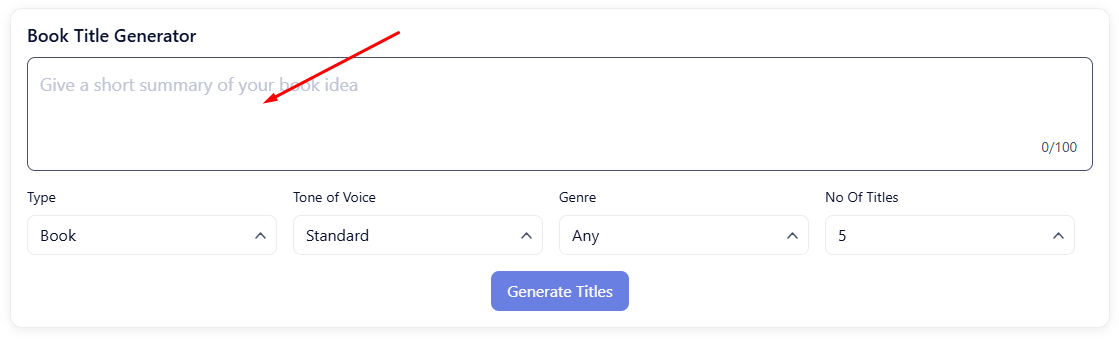
After that, choose the book theme, tone, and number of titles you want before clicking on the “Generate Titles” button.
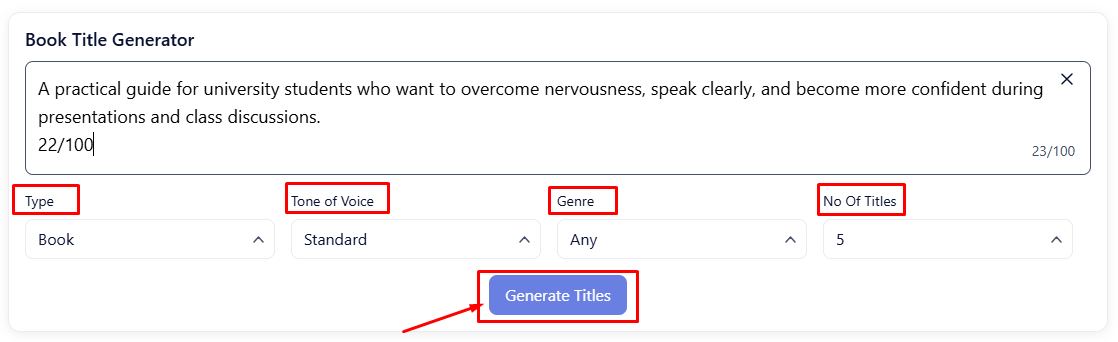
The important part is what you do after generating the ideas. Treat the tool’s output as a spark. Compare the title ideas against your book’s main theme. Then, shortlist three to five best suggestions.
Often, a generated title may become great after a few manual tweaks, rather than direct use. The tool shouldn’t replace your creativity; feed it.
Test Your Title Before Finalizing It
Now that you have a shortlist (of at least three to five titles), it’s time to put them through a few real world tests.
First of all, read each title aloud. Does it roll off the tongue easily? Does it sound natural? Does it feel easy to say and remember? Then, search them online. If ten other books share the same title, yours may get lost. If the title has no obvious matches, that can make it easier for readers to distinguish your book from others.
Ask someone else (who doesn’t know about your manuscript) to look at your top choices. Don’t simply ask: “Do you like it?” Ask these questions instead:
What kind of book would you expect from this title?
Which title do you remember most easily?
Does anything about a title confuse you?
The answers can reveal a lot! You might have never noticed a few of those points since you already know what’s written inside the book.
Finally, imagine your book on a bookstore shelf with only its title visible. Would you reach for it (be totally honest here)?
The title that performs best across these tests can be your likely winner.
Wrapping Up
A catchy book title doesn’t appear in a flash of genius; it’s built. Follow the practical strategies described in this guide. To get the most out of this process, avoid mistakes like making the title too vague, too generic, too long, or irrelevant to your genre.
And remember! Your title doesn’t have to be perfect. It should sound right and feel like it does justice to the words inside the book.